

Before the glare of streetlights swallowed the night sky, humanity was much more keenly aware of the cycle of changes exhibited there. The monthly path and phases of the moon, along with the yearly cycle of the Sun's risings and settings were noted, tracked, and followed for their religious and economic (i.e. agricultural) significance. People also tracked the motion of the planets—the bright points of light that wandered in less obvious cycles across the background of fixed, twinkling stars.
A particularly baffling aspect of planetary motion was when a planet would appear to change direction and move backwards. A planet such as Mars would spend much of the year moving slowly eastward against the background of fixed stars. Then, to everyone's surprise, it would change direction and slide westward for a couple of months or so before stopping again and returning to its easterly path. This is retrograde motion (retro meaning backward).
Ancient astronomers and philosophers believed the heavens, the realm of the gods, should be perfect, and planets would therefore have to move perfectly—perfect circles and constant speeds. Explaining retrograde motion therefore proved a major challenge to those advocating a Geocentric universe (where Earth was at the center of everything). To retain the perfection of circular motion, and to account for retrograde motion, ancient astronomers proposed that planetary orbits consisted of two components, a deferent and an epicycle. A planet's deferent was a circle centered on Earth (like an orbit), and its epicycle was a smaller circle whose center travelled along the deferent. As seen from Earth, the motion around the epicycle caused the planet to appear to move backwards and forwards and therefore accounted for retrograde motion!
It took almost 2,000 years before the Greek dream of knowing the solar system's true geometry was realized. In the 1400s, the brilliant Polish astronomer, Nicholas Copernicus, devised a heliocentric (Sun-centered) model for the solar system. In his model, all the planets now orbited the Sun, with inner planets completing their years faster than the outer planets. The dual-component orbits were unnecessary in Copernicus's heliocentric system, as retrograde motion was explained by rapidly-moving inner planets overtaking the slower-moving outer worlds. Still, when Copernicus proposed his Heliocentric model (that we now know to be true) it met with considerable resistance even though it was more simple and elegant.
Your goal is to explore what causes the planets in our solar system to trace a complex path across our sky as they orbit the Sun, including times when the planets appear to move backward (retrograde motion)! In this interactive you will see two views nested inside each other. The inner portion is an overhead view of the inner solar system based on the cosmological model you choose. Surrounding this is the view of the annual night sky of the planet you are observing from.
There are several control options.
- Choose to view the solar system either as described by the heliocentric or geocentric model.
- Pause the simulation at any time.
- Use Directional Coloring to have the planet you are observing change color in the night sky as it changes direction.
- Show a Trace of the path of the planet you are looking at, color-coded to indicate the planet's direction. Remove the trace with the Clear Trace button.
- You can adjust the size of the orbit of Mars (heliocentric model) or the deferent of its orbit (geocentric model) by clicking and dragging the large white circle (or tabbing to it and using the arrow keys).
To be able to easily show the retrograde motion on-screen, in this simulation, the orbital periods do not follow Kepler's laws – Mars moves slower compared to Earth (heliocentric model) or the Sun (geocentric model) than you would expect. The simulations are matched when Mars's orbit is at it's normal size (228 million km), but may behave differently for other radii.
If the sound is on, you will hear tones indicating the speed and direction of the observed planet. The main tone always indicates Eastward (forward) movement, all others indicate the apparent speed of retrograde motion.
Note: The retrograde motion in this simulation is exaggerated for clarity.
Your goal is to explore how heliocentric vs. geocentric (Sun-centered vs. Earth-centered) models of the solar system explain apparent retrograde motion.
This simulation is divided into 3 regions: First, the title banner with the audio on/off and info buttons. Second, the navigation options. Third, the controls region where you can choose a cosmological model, decide which planet to be observing from, which to be looking at, and even adjust orbital radii. Visit the How To tab for details.

Close
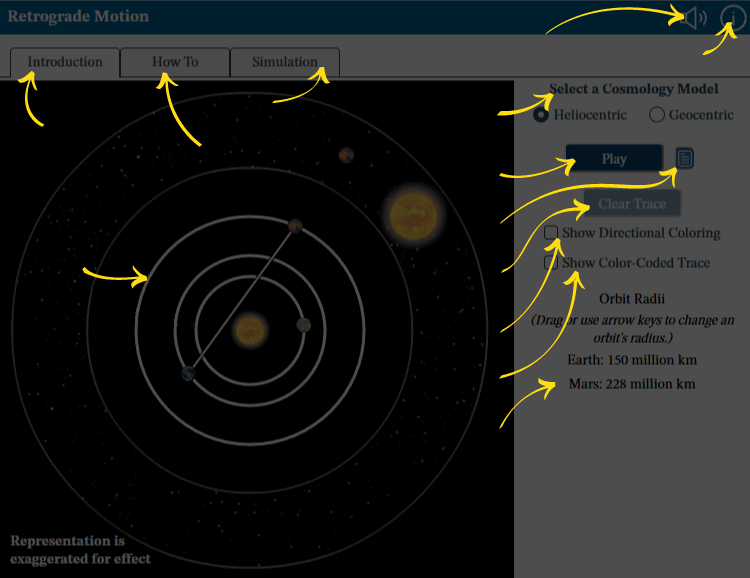
Audio: Turn sounds off or on. See How To tab for details on what the sounds indicate.
Information: Reopen this overview screen.
Introduction tab contains background information about the subject of the simulation.
How To tab contains detailed information about how to use the simulation.
Simulation tab contains the simulation.
Select a Cosmology Model: Choose whether the Sun or Earth is at the center of the solar system.
Play or Pause: Start and stop the action in the simulation.
Open Text Description: Opens a detailed description of the current state of the simulation.
Use Clear Trace to remove all visual indications of previous motion. (Only available if “Show Color-Coded Trace” option is selected.)
Show Directional Coloring: Check this box to color the planet you are looking at based on the direction it is travelling and its velocity.
Show Color-Coded Trace: Check this box to show dots that indicate direction and velocity by color and spacing.
Current Orbit Radii; adjust the orbit rings to change these values.
Orbit Rings: Adjust with mouse or keyboard to change a planet's orbit radius.